

I Want to Play Soccer Again: How to Get Back Into Soccer Shape Without Getting Injured

Updated: Jun 23
Maybe you're watching the World Cup, following your favorite club, or seeing friends join local leagues and feeling the itch to play soccer again.
Maybe you played in high school, college, or recreational leagues years ago. You still consider yourself athletic. You can go for a run, hit the gym, hike the trails around Boulder, or stay active with other sports.
But soccer is different.
One of the biggest mistakes returning players make is assuming that because they feel fit enough to play, their body is prepared for the demands of a full soccer game.
Getting back into soccer isn't just about improving fitness. It's about preparing your body to handle sprinting, cutting, decelerating, jumping, kicking, and repeated impacts without breaking down.
As a physical therapist in Boulder who works with active adults and athletes (and as a competitive soccer player who still plays multiple times each week) I've seen this pattern repeatedly. Someone feels healthy enough to play, joins a league, gets through the first game, and then spends the next several weeks dealing with knee pain, Achilles soreness, a calf strain, groin pain, a lingering hamstring injury, or worse, a significant injury that keeps them off the field.
The problem is fitness and soccer readiness are not the same thing.
More often, cardiovascular fitness returns much faster than the body's ability to tolerate the forces that soccer demands. Sprinting, cutting, decelerating, changing direction, and absorbing impact require a level of tissue capacity, movement control, and neuromuscular coordination that many recreational athletes haven't trained in years.
In other words, your lungs may be ready for soccer long before your muscles, tendons, and joints are.
That's why so many returning players can run a few miles, complete a workout, or finish a hike, but struggle to recover from a single soccer match.
Most soccer injuries are preventable.
In this guide, you'll learn what soccer really demands from your body, how to determine whether you're ready to play, and how to rebuild soccer-specific fitness so you can safely return to the sport you love.
Why Soccer Is Harder on Your Body Than You Remember
Many adults return to soccer assuming the biggest challenge will be getting their conditioning back.
While endurance matters, soccer is much more than jogging for 90 minutes.
Soccer is a sport built around repeated bursts of force. Every sprint, cut, jump, landing, tackle, and change of direction places stress on your muscles, tendons, joints, and nervous system. During a match, your body may be required to produce and absorb force hundreds of times, often in unpredictable situations.
This is why many returning players are surprised when they can comfortably run a few miles but feel completely different after a single soccer game.
Sprinting
Soccer requires frequent short, explosive bursts of speed.
Whether you're making a run into space, tracking back on defense, or chasing a loose ball, sprinting places significant demands on the calves, Achilles tendons, hamstrings, hip flexors, and glutes.
Unlike steady-state running, sprinting generates much higher forces that your tissues must be prepared to tolerate.
Cutting and Changing Direction
Very few movements in soccer happen in a straight line.
Players are constantly planting, pivoting, shuffling, and changing direction in response to opponents, teammates, and the ball.
Each cut creates substantial forces through the ankles, knees, hips, and pelvis. If the body lacks strength, stability, or control, those forces often show up as knee pain, ankle sprains, groin strains, or recurring muscle injuries.
Deceleration
One of the most overlooked demands in soccer is deceleration.
Most people think about acceleration: how quickly they can sprint. Far fewer think about their ability to slow down.
Yet every time you stop, cut, land from a jump, or change direction, your body must absorb force before it can create force again.
In many cases, deceleration places greater demands on the body than acceleration itself.
If your body struggles to absorb force efficiently, that stress often shows up as Achilles pain, calf strains, knee pain, hamstring injuries, or the nagging soreness that seems to linger longer after every game.
Repeated Efforts and Endurance
The challenge isn't just producing force once, but it is doing it over and over again throughout an entire match.
Your body must repeatedly sprint, decelerate, cut, jump, land, react, and recover while fatigue gradually builds. This is why cardio is often the least of your worries.
Many returning players have enough fitness to get through a game. What they often lack is the ability to repeatedly tolerate the forces that soccer places on the body.
Before worrying about how many miles you can run, it's worth asking a more important question: Can your body actually handle the demands of soccer?
The Biggest Mistake Adults Make When Returning to Soccer
The most common return-to-soccer plan looks something like this:
Sign up for a league.
Play a full game.
Wake up sore.
Keep playing anyway.
Develop knee pain, calf tightness, Achilles pain, hamstring strains, groin pain, or hip pain.
Assume the body just needs more time to adjust.
Unfortunately, that's often where the injury cycle begins.
Many returning players continue playing through symptoms because they assume the pain will eventually disappear as they get back into shape. Sometimes it does. Often it doesn't.
Instead, the irritation gradually builds until a small problem becomes a bigger problem that limits playing time or forces them to stop playing altogether.
The issue is rarely that you're "too old" for soccer. More often, there is a mismatch between what soccer demands and what your body is currently prepared to handle.
Many adults focus almost entirely on fitness. They want to improve their conditioning so they can keep up with the pace of the game, but fitness is only one piece of the puzzle.
You may have enough cardiovascular fitness to play for 90 minutes, but that doesn't necessarily mean your muscles, tendons, joints, and nervous system are ready for 90 minutes of sprinting, cutting, decelerating, jumping, and kicking.
Successful returns to soccer depend on more than conditioning. They require adequate tissue capacity, movement control, and recovery in addition to fitness.
When those factors are aligned, the body adapts. When they aren't, injuries often follow.
Before returning to soccer, it helps to understand where your body currently stands.
Before You Play, Can Your Body Handle Soccer?
Before jumping into a full match, it's helpful to identify potential weak links that could increase your risk of injury.
In the clinic, these are some of the same qualities I assess when helping soccer players return to the field after injury or time away from the sport. These are some of the tests I would use in a thorough evaluation.
Single-Leg Balance Test
Stand on one leg for 30 seconds.
This simple test provides insight into your stability and control. If you're constantly wobbling, reaching for support, or notice a significant difference between sides, it may indicate deficits that become more apparent during sprinting, cutting, and changing direction.
Single-Leg Sit-to-Stand Test
Sit in a chair and stand up using only one leg.
Pay attention to whether your knee collapses inward, you lose balance, or you need momentum to complete the movement.
This test challenges hip, knee, and ankle control simultaneously. Since soccer is largely a single-leg sport, poor control here may become more noticeable when running, cutting, landing, or kicking.
Single-Leg Calf Raise Test
Stand on one leg and perform as many controlled calf raises as possible through your full range of motion.
A soccer player planning to play a full 90-minute game (or even a significant portion of one) should generally be able to perform at least 30 quality repetitions on each side.
This is an entry-level assessment of the calf and Achilles complex's ability to tolerate the forces associated with jogging, sprinting, cutting, and jumping. If you fatigue quickly or notice a large difference between sides, your lower leg may not be fully prepared for the demands of soccer.
Hop and Stick Test
Stand on one leg, hop forward, and stick the landing.
The goal is control, not distance.
Can you absorb the landing quietly? Can you maintain your balance? Does your knee stay aligned?
This test provides a simple look at force absorption, which is one of the most important and overlooked components of injury prevention. Many soccer injuries occur not because the body can't create force, but because it struggles to absorb force efficiently.
Lateral Bound Test
Jump sideways from one leg to the other and hold the landing for several seconds.
Soccer rarely happens in a straight line. Players are constantly reacting, cutting, and changing direction.
The lateral bound test challenges your ability to control side-to-side forces and can provide insight into your readiness for the demands of cutting and change-of-direction movements.
What These Tests Really Tell You
These tests aren't designed to determine whether you can or can't play soccer.
They're designed to identify limitations before they become injuries.
If you struggle with balance, single-leg strength, force absorption, or lateral control, it doesn't mean you need to avoid soccer. It simply means those areas may deserve attention before you jump into a full game.
Addressing those limitations now is often much easier than dealing with knee pain, Achilles pain, calf strains, or other injuries once the season has already started.
Colin helped me recover and strengthen from consistent achilles issues and a hamstring strain. More importantly, the routine and strengthen work Colin showed me has me feeling stronger and more flexible in my mid 50s on the soccer pitch than ever. Truly game changing for my movement. - Erik S
How to Build Soccer Fitness the Right Way
Once you understand your starting point, the next step is rebuilding soccer-specific fitness.
The goal isn't just to improve conditioning. The goal is to gradually prepare your muscles, tendons, joints, and nervous system for the demands of sprinting, cutting, decelerating, jumping, and kicking.
One of the biggest mistakes returning players make is doing too much too soon. Your body adapts best when training loads increase gradually over time.
Start With Walking and Jogging
Before worrying about sprinting or playing a full match, establish a basic aerobic foundation.
Walking and jogging allow your calves, Achilles tendons, knees, hips, and feet to gradually readapt to the repetitive loading demands of running.
Add Jumping, Acceleration, and Sprint Work
Soccer is not a steady-state running sport.
Once jogging feels comfortable, begin introducing jumping, acceleration drills, and short sprint efforts. These movements help prepare your body for the higher forces it will encounter during competition.
Train Lateral Movement
Soccer requires movement in every direction.
Incorporate side shuffles, crossover steps, lateral lunges, and controlled change-of-direction drills to prepare for the demands of cutting, defending, and reacting to the game.
Practice Deceleration
Every sprint eventually requires a stop.
Every cut requires your body to absorb force before changing direction.
This is why deceleration training is so important. Sprint-and-stop drills, landing drills, and controlled change-of-direction exercises help develop your body's ability to absorb force safely and efficiently.
Don't Forget to Swing the Legs
Kicking places significant demands on the hips, groin, hamstrings, core, and supporting leg.
Many returning players are surprised by how sore they become after repeatedly passing, crossing, or shooting.
As your training progresses, gradually reintroduce kicking drills so your body can rebuild tolerance to one of the most unique demands of soccer.
The closer your training matches the actual demands of the sport, the more prepared your body will be when it's time to step back onto the field.
The Strength Exercises Every Returning Soccer Player Should Prioritize
You don't need a complicated strength program to prepare for soccer.
In fact, most returning players benefit more from focusing on a few key movement categories than chasing the latest workout trend.
The goal isn't simply to get stronger, but to build the strength necessary to sprint, cut, decelerate, absorb force, and stay resilient throughout a season.
Single-Leg Strength
Soccer is primarily played on one leg.
Every stride, cut, jump, landing, and kick requires the ability to produce and control force through a single limb.
Exercises such as split squats, lunges, step-ups, and step-downs can help develop the single-leg strength needed for soccer while also exposing side-to-side differences that may increase injury risk.
Glute Strength
Strong glutes contribute to both force production and force absorption.
They play a major role in sprinting, changing direction, controlling the pelvis, and reducing excessive stress on the knees and lower legs.
For many athletes, improving glute strength can improve both performance and movement efficiency.
Core Control
The core acts as the bridge between the upper and lower body.
When the trunk and pelvis are stable, force can be transferred more efficiently during running, sprinting, kicking, and changing direction.
Core training for soccer should focus on control and stability rather than endless crunches.
Calf Strength
Few muscle groups work harder in soccer than the calves.
They help absorb force during landing, contribute to sprinting speed, and place substantial demands on the Achilles tendon throughout a match.
Because of this, calf strength and endurance are often critical components of injury prevention and performance.
Ankle Strength
Building resilient ankles can improve both confidence and durability on the field. Soccer players constantly react to uneven surfaces, awkward landings, tackles, and sudden changes in direction. If the ankle lacks strength and reactive control in multiple directions, the risk of an ankle sprain increases significantly.
The best strength programs don't try to mimic soccer. Instead, they build the physical qualities that allow you to handle soccer's demands more effectively and with less risk of injury.
Why Stretching Alone Won't Prepare You for Soccer
When many adults decide to get back into soccer, stretching is often the first thing they do.
And while mobility matters, stretching alone won't prepare your body for the demands of the game.
Soccer injuries rarely occur because someone forgot to stretch their hamstrings before a match.
More often, injuries occur because the body struggles to control and absorb force during sprinting, cutting, landing, and changing direction.
That's why stretching and foam rolling should be viewed as tools, not complete solutions.
Improving flexibility may help you move more comfortably, but it doesn't automatically improve strength, force absorption, balance, deceleration, or change-of-direction control.
The same is true for foam rolling. It may temporarily improve how you feel, but it doesn't significantly increase your body's capacity to handle the demands of soccer.
This is where neuromuscular control becomes important.
Neuromuscular control is your body's ability to coordinate movement efficiently and react appropriately to changing demands. When that system is working well, forces are distributed more effectively throughout the body.
When it's not, compensation patterns often develop.
For example, limited hip control may increase stress on the knee. Poor force absorption may place additional strain on the Achilles tendon or calf. Over time, these inefficient movement patterns can contribute to recurring pain and injury.
The goal is to move efficiently, absorb force effectively, and build the physical capacity required to play soccer safely. Stretching can be part of that process. It just shouldn't be the entire plan.
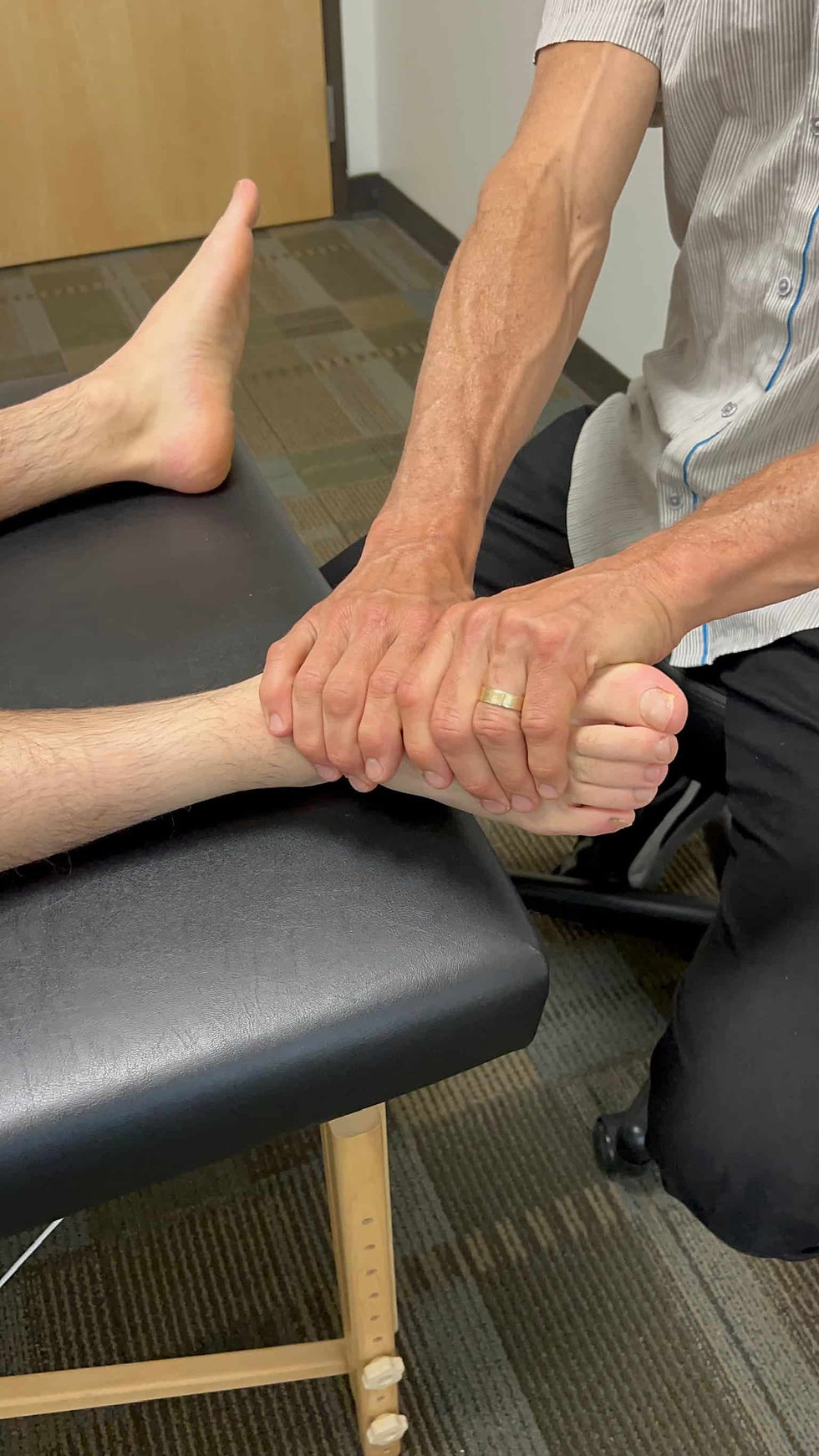
In an evaluation and with a treatment plan we'll combine exercise with supporting technology such as blood flow restriction to build strength and shockwave therapy to address pain.
Warning Signs Your Body Isn't Ready To Play Soccer Yet
Some soreness is normal when returning to soccer.
Persistent pain, recurring symptoms, and excessive stiffness are not.
If you consistently experience any of the following after playing, your body may be telling you that there's a gap between the demands of soccer and your current capacity to handle them.
Your Hamstrings Always Feel Tight
Many players assume tight hamstrings simply need more stretching.
In reality, persistent hamstring tightness can sometimes be a sign that the muscles are working overtime to compensate for limitations elsewhere, such as reduced hip strength, poor force absorption, or inefficient movement patterns.
You Develop Knee Pain After Playing
Knee pain is one of the most common complaints among returning soccer players.
While the knee is often where symptoms show up, the underlying issue may involve how forces are being managed throughout the entire lower body during sprinting, cutting, deceleration, and landing.
You Have Groin Soreness That Lingers
It's not unusual to feel some groin soreness when returning to kicking, sprinting, and changing direction.
However, soreness that lingers for several days after every game may indicate that the tissues are being asked to handle more than they're currently prepared for.
Your Achilles Is Stiff the Next Morning
Morning Achilles stiffness is a common early warning sign that the tendon may not be tolerating current training or playing loads particularly well.
Many players ignore it until the stiffness gradually progresses into persistent Achilles pain.
You Experience Low Back Pain After Games
Soccer places significant demands on the hips, core, and lower body.
When movement efficiency breaks down or compensation patterns develop, the lower back often absorbs stress that should be distributed elsewhere.
Listen to What Your Body Is Telling You
Many soccer injuries don't appear overnight.
They often begin with subtle warning signs that are easy to ignore: recurring tightness, lingering soreness, morning stiffness, or pain that keeps showing up after every game.
Paying attention to these early signals can help you address problems before they become injuries that keep you off the field.
Work With a Soccer Injury Specialist in Boulder
Returning to soccer doesn't have to mean dealing with recurring injuries, nagging pain, or spending weeks recovering after every game.
Whether you're getting back on the field for the first time in years, preparing for an upcoming season, or trying to stay healthy throughout league play, the right plan can help reduce your risk of injury and improve your confidence on the field.
At Colin O'Banion Physical Therapy, I help active adults and athletes identify movement limitations, improve force absorption, build soccer-specific strength, and safely return to the activities they enjoy most.
If you're looking for a soccer injury specialist in Boulder, sports physical therapy in Boulder, or return-to-sport physical therapy, I'd be happy to help. Here are some points to consider when you're looking for a therapist.
Schedule an evaluation to discuss your goals, assess your movement, and create a personalized plan to help you get back to playing soccer with confidence.

How to Connect with Me:
Colin O’Banion, Doctor of Physical Therapy
Colin is a licensed Physical Therapist and founder of Colin O’Banion Physical Therapy in Boulder, Colorado. With 20 years of experience, he specializes in solving complex and chronic pain cases through a root-cause, integrative approach. Colin combines expert manual therapy with powerful tools like shockwave therapy, blood flow restriction therapy, dry needling, and movement re-education to help clients return to the activities they love. His one-on-one practice is dedicated to clients seeking lasting solutions when traditional PT has fallen short.


Comments