

Does Shockwave Therapy Work for Tendonitis That Keeps Coming Back?

Updated: Oct 22
If you're reading about shockwave therapy, chances are you found it while searching for something that might finally work to address persistent tendonitis.
Maybe it's your Achilles, your elbow, your knee, or the bottom of your heel that has been bothering you for months... maybe years.
You've done all the right things: rested, iced, and maybe you've even done some physical therapy. It settles down, you get back to running, lifting, or pickleball, and it flares up again.
If you've come across shockwave in your search for the next solution, I'm not surprised. It's non-invasive, there's solid research behind it for chronic tendon problems, and people say it helped when nothing else did. It's fair to wonder if this is what you've been missing.
In my experience, shockwave is the best modality we currently have for treating tendon issues, and I use it with many of my clients.
With a caveat: I've also seen that it's not usually not enough to get the long-term fix we're ultimately looking for. It's best supported by the right exercises and hands-on therapy.
So before you book a series of sessions for that chronic tendon issue you've been dealing with, it helps to know what shockwave actually does, who it's right for, and what needs to go with it so the pain doesn't come right back. That's what this post covers.
Why Tendonitis Keeps Coming Back
Rest usually calms an irritated tendon down. What it doesn't do is make the tendon stronger or better able to handle what you want to ask of it.
Let's say you're a runner with hamstring pain. You take a few weeks off and it improves. You start running again, and within a week or two you're right back where you started. Rest reduced the irritation, but the tendon can't tolerate the forces of running any better than it could before.
Most people call this "tendonitis," which technically means inflammation of a tendon. When pain has lasted for months, it's usually better described as tendinopathy, meaning the tendon has changed in how it responds to and tolerates load. Inflammation can still play a part, but chronic tendon pain usually isn't an ongoing inflammatory problem. That's why ice, anti-inflammatories, and rest often don't hold up.
You can learn about this in a bit more detail on this page.
Tendons also typically have poor blood flow, which is a big part of why they're slow to heal. That's where shockwave comes in.
How Does Shockwave Therapy Work on Tendons?
Shockwave delivers acoustic pressure waves into the targeted tissue. These pulses stimulate biological responses involved in tissue repair and can increase local circulation, which matters in a tissue with a poor blood supply.
I think of shockwave as a way to help stimulate the healing process, while progressive loading helps the tendon adapt to the demands you'll eventually put on it. I use the two together, and the research points the same way. In one randomized trial of people with Achilles pain lasting more than six months, adding shockwave to a loading program led to better results at four months than loading alone. By one year the groups had evened out, partly because many people in the exercise-only group went on to add shockwave.
What to Expect From Shockwave Therapy With Me
I've had many clients who "tried everything" before coming to me, and I've seen great results once we incorporate shockwave into their treatment. Many people notice a change within the first 1 to 3 sessions, though everyone responds differently.
I have been dealing with patella tendonitis for the last 6 years and have been unable to really get it under control until working with Colin. Not only do I feel better when I'm lifting, but I've noticed a HUGE drop in how much pain I'm experiencing the day after a heavy lifting day.
- Celia, competitive Olympic weightlifter (Google review)
Before I start, I take you through a detailed process to pinpoint the exact location of the problem, so we're targeting the right spot. I use the Storz D-ACTOR 100 Ultra, a Swiss-made device with nine different treatment heads. Each head has its own intensity, depth, and width, which lets me customize the treatment to your specific tendon and your needs.
We stay in constant communication throughout. Treatment can be intense, and my goal is always to find the right balance between effectiveness and your comfort. Each area takes about 5 minutes.
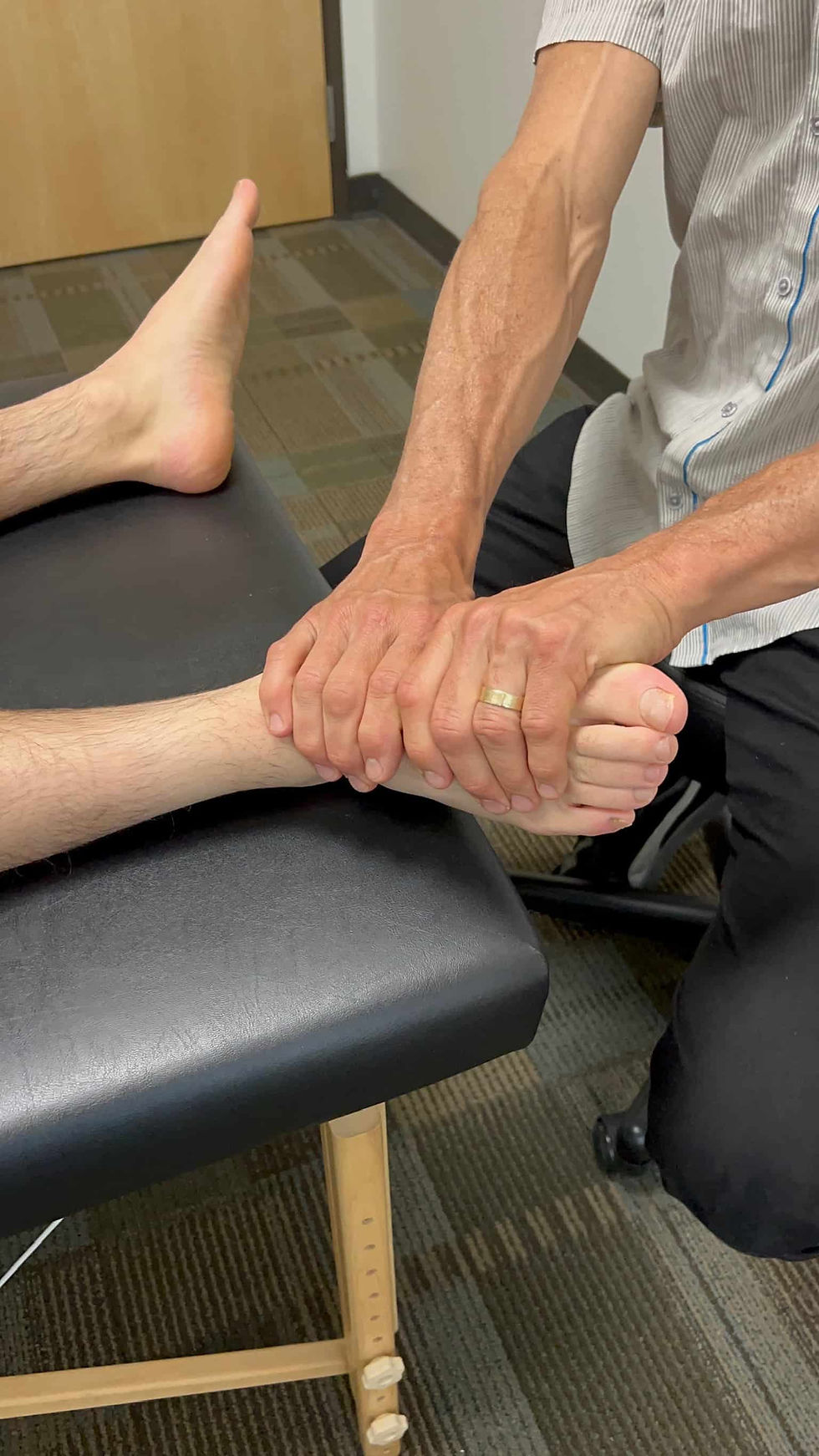
I usually recommend 3 to 5 shockwave treatments, about one week apart. Along with shockwave, I do soft tissue work using manual therapy and/or dry needling. I treat the tendon along with the muscles that attach to it, and we work on a few specific exercises.
Which Tendon Problems Does Shockwave Therapy Help?
Tendon problems I commonly treat with shockwave include:
Achilles tendinopathy
Tennis and golfer's elbow
Patellar tendinopathy (jumper's knee)
Rotator cuff tendinopathy
Hip tendon pain
Calcific tendonitis
Plantar fasciitis
Still, not every painful tendon needs shockwave. I consider how long symptoms have been present, which tendon is involved, what you've already tried, and how the tendon responds to loading. I also want to confirm the pain is actually coming from the tendon and that shockwave is appropriate for that condition.
Research reviews show shockwave can improve pain in several tendon problems, including tennis elbow, Achilles tendinopathy, and rotator cuff tendinopathy, but results vary by condition, and not everyone responds. So I don't automatically recommend it to everyone with tendon pain. I want to understand the problem first and decide whether it's likely to add meaningful benefit to your plan.
Why Shockwave Therapy Alone Usually Isn't Enough
If shockwave helps a tendon heal, why does the pain still come back for some people? In my experience, it's because whatever overloaded the tendon in the first place never changed. Here's what I put around shockwave so the results last.
Tendon-Loading Exercises, Progressed the Right Way
Current science supports that tendons need to be loaded in a very specific manner, and that load needs to be gradually increased. The physical therapy clinical practice guideline for Achilles tendinopathy gives its strongest recommendation to tendon-loading exercise as first-line care.
Here's why loading helps. When you load a tendon, fluid gets pushed in and out of it, a bit like squeezing and releasing a sponge. That movement brings in nutrients and supports healing. Because tendons typically have poor blood flow, we need to increase this healing activity without irritating the tendon.
The trick is how to do this. What's enough to help the tendon adapt, and what's too much and keeps the irritation going? I give you a few specific exercises, find the right starting load, and progress it in a way that builds tendon resilience instead of flaring it up. These aren't necessarily complicated exercises, but how we perform them and how we progress them is extremely important.
Looking Beyond the Tendon
My evaluation looks at the whole body, understanding how everything connects and supports each other. Pain in a tendon doesn't mean the tendon is the only problem.
For instance, if you have elbow tendonitis, I always want to make sure the shoulder and the neck are healthy and working right. Often, they are not, and this is one of the underlying issues that might not have been previously addressed. With Achilles tendinopathy, I look at ankle mobility, calf and hip strength, and how you walk or run.
I'm looking for weaknesses, inflexibility, lack of mobility, and movement patterns that may be putting extra stress on the tendon. Then we specifically address them. Sometimes the tendon is compensating for a limitation somewhere else, and until that's addressed, it can keep getting overloaded.
"I had also been having knee pain and weakness which Colin figured out could be related to my plantar fasciitis.
- Frank (Google review)
Staying Active While Your Tendon Heals
Part of my job is education on what not to do, so the irritation can calm down without you giving up everything you enjoy.
If lifting is aggravating the tendon, I'll give you ways you might be able to keep training without irritating it, such as changing your grip, exercise selection, or weight and volume. For runners with Achilles pain, that might mean temporarily adjusting how often you run, or cutting back on hills and speed work. We also adjust how you move through everyday activities so the tendon isn't stressed all day long.
As symptoms improve and the tendon gets stronger, we gradually bring back the activities that used to aggravate it.
When shockwave is supported by education on what not to do, modifications, the right exercises, and addressing what the evaluation finds, we get a well-rounded treatment plan that has much greater potential for long-term relief.
Can Vitamin C Help Tendons Heal?
In your own research you may have heard that supplements can help with tendon issues. Vitamin C is necessary for collagen production, and early research, mostly in lab and animal studies, suggests it may support tendon healing. In a small study of healthy men, taking vitamin C with gelatin (which is rich in proline) before exercise doubled a blood marker of collagen production. It's promising, though not yet proven for tendon pain specifically.
I share a vitamin C and L-proline protocol with my tendon clients as support for the main work. Supplements don't replace progressive loading or addressing what's contributing to the problem.
Frequently Asked Questions: Shockwave Therapy for Tendonitis
How many shockwave sessions will I need?
I usually recommend 3 to 5 treatments, about one week apart. Many people notice a change within the first 1 to 3 sessions, though everyone responds differently, and I adjust based on how you respond.
Is shockwave therapy painful?
It can be uncomfortable, especially on a tendon that's already sensitive. Most people tolerate it well, and I can adjust the intensity. Some temporary soreness afterward is possible.
Can I keep running, lifting, or playing pickleball during treatment?
In many cases, yes, with some modifications. I'd rather keep you as active as possible than have you stop everything. The key is adjusting activity so we're not repeatedly aggravating the tendon.
How long does it take for chronic tendinopathy to improve?
It varies. Some people notice improvement within a few weeks, but building real load tolerance in a tendon often takes several months of progressive strengthening. The full rehab process usually runs longer than the shockwave series itself.
Does shockwave therapy work without exercises?
Some people get pain relief from shockwave alone, but I don't consider it a complete plan for chronic tendinopathy. Progressive loading is what improves the tendon's ability to handle the demands of your activities.
What if I've already tried physical therapy and it didn't work?
I see that fairly often. Previous PT may have helped for a while, but there may be contributing factors that weren't fully identified or addressed. I'll want to know what you've tried, how your exercises were progressed, and whether limitations elsewhere in the body might be playing a role.
Shockwave Therapy for Tendonitis in Boulder
If you've been reading about shockwave and wondering whether it's the answer for your tendon, it may well be a big part of it. In my experience, it does its best work as part of a well-rounded plan: education on what to avoid, modifications that keep you active, specific exercises that build tendon resilience, and a whole-body evaluation that finds what else is contributing.
At Colin O'Banion Physical Therapy in Boulder, I work one-on-one with active adults and athletes, many of whom have already tried other treatments without the results they wanted.
Book a free 15-minute consultation call, and we can talk through your tendon pain, what you've tried, and whether shockwave makes sense for you.

This article is for general educational purposes and is not a substitute for personalized medical advice. If you have pain, a health condition, or concerns about exercising safely, talk with a licensed physical therapist or your health care provider.
How to Connect with Me:
Colin O’Banion, Doctor of Physical Therapy
Colin is a licensed Physical Therapist and founder of Colin O’Banion Physical Therapy in Boulder, Colorado. With 20 years of experience, he specializes in solving complex and chronic pain cases through a root-cause, integrative approach. Colin combines expert manual therapy with powerful tools like shockwave therapy, blood flow restriction therapy, dry needling, and movement re-education to help clients return to the activities they love. His one-on-one practice is dedicated to clients seeking lasting solutions when traditional PT has fallen short.


Comments