

I Threw My Back Out. What Should I Do?

Updated: Sep 24
Maybe you bent over to pick something up. Maybe you were tying your shoes, making the bed, sneezed, or simply turned around too quickly.
If you’re a gym-goer, maybe it happened during a deadlift or squat. Or maybe you did virtually nothing and suddenly you back just went out.
When someone tells me they “threw their back out,” the story often sounds something like this:
“I bent over and felt something happen in my low back. Then, over the next hour, all the muscles tightened up. Now I’m in a lot of pain, I feel incredibly stiff, and simple things like rolling over in bed or getting out of a chair hurt.”
So, what should you do?
If you just threw your back out, the first priorities are to avoid repeatedly aggravating it, find positions and movements that reduce your symptoms, and keep moving within tolerable limits. And don’t automatically assume that because your back feels tight, you need to stretch it.
Yes, motion is lotion, but more often than not it’s specific motion.
In the short term, the goal is to calm things down and get you moving normally again. But there’s another question that matters, especially if this has happened before:
Why did your back go out in the first place?
Most episodes of throwing your back out are mechanical and can be managed conservatively, but certain symptoms require prompt medical attention. I’ll cover those below.
Should I See a Physical Therapist Right Away or Wait?
A lot of people wait. They think: “I’ll let this calm down for a week and then I’ll go get it checked out.”
That’s okay in some situations. But you don’t necessarily have to wait until the pain and muscle spasm are gone before seeing a clinician.
A good clinician should have the knowledge and tools to evaluate you even when you’re moving poorly and in significant pain.
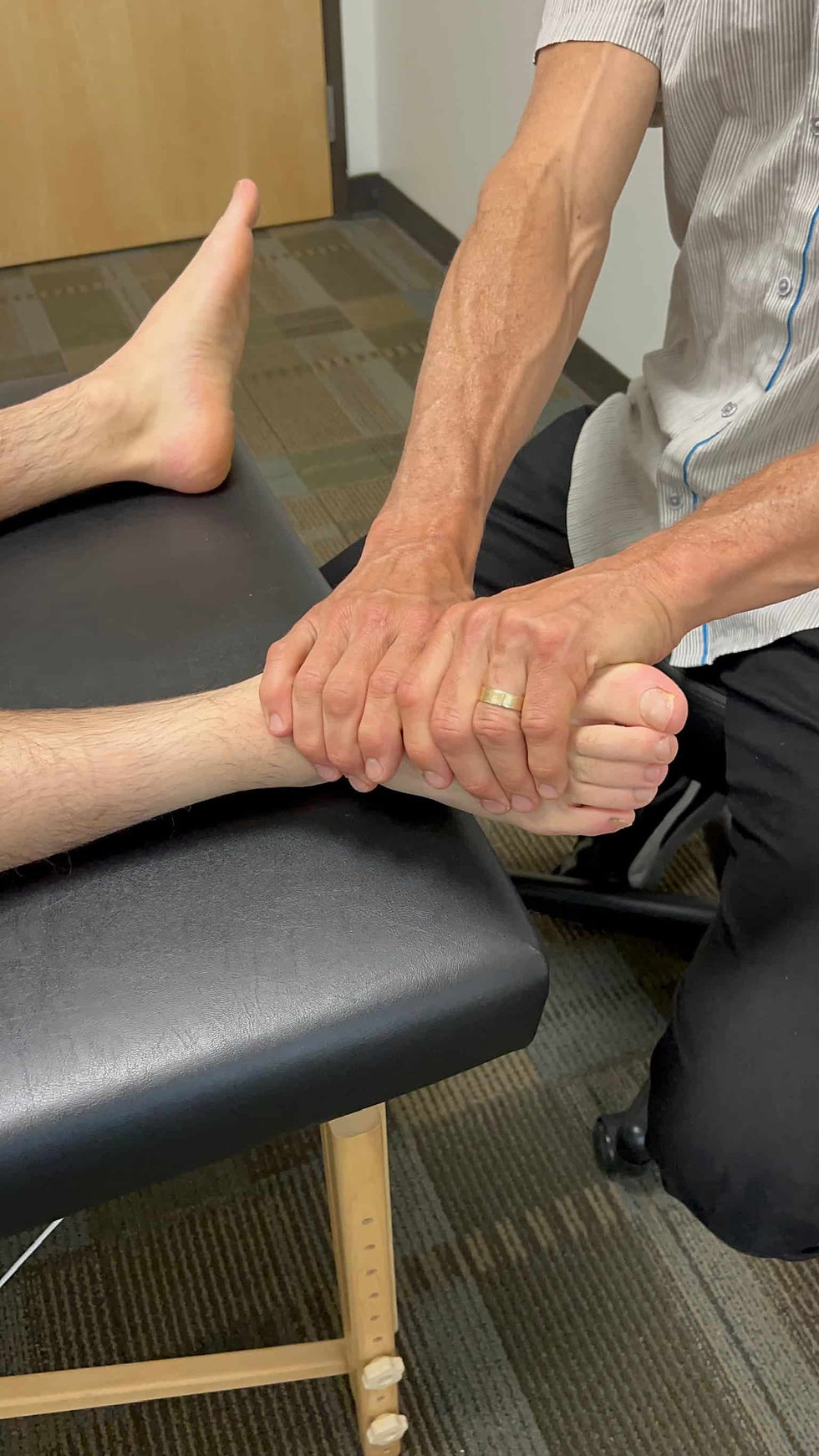
In my practice, the immediate goal is to determine what movements and positions your back currently tolerates, use hands-on treatment and other modalities when appropriate, reduce pain and muscle guarding, mobilize what is stiff, stabilize what needs stability, and give you a few specific things to do at home.
Often people walk out an hour later feeling dramatically better.
That doesn’t happen every time. Sometimes the improvement is more gradual and becomes noticeable over the following few days. At the very least, the goal of treatment during this stage is to help speed up the recovery process and give you a better understanding of what you should and shouldn’t be doing.
Then, once things have settled down, we can turn more attention toward the bigger question: why did this happen in the first place?
First: When Should You Seek Medical Attention for Sudden Back Pain?
Most episodes of mechanical low back pain can be managed conservatively, but not every episode of sudden back pain should be treated on your own.
Seek prompt medical evaluation if your back pain is associated with:
New bowel or bladder dysfunction
Numbness around the groin or saddle area
Significant or progressive leg weakness
Major trauma
Fever or other signs of systemic illness
Other severe or unusual symptoms that concern you
If you’re unsure about what you’re experiencing, it’s appropriate to get evaluated.
What Should You Do After Throwing Your Back Out?
Every person and every back flare-up is different. There isn’t one exercise, stretch, or treatment that is appropriate for everybody.
The best answer is always going to depend on what is actually causing your particular symptoms.
That said, there are some patterns. If I’m on a consultation call and don’t know much more about their particular situation yet, these are three simple things I will often discuss.
1. Be Careful With Stretching
When your back feels incredibly tight, the natural reaction is to stretch it.
Be careful.
A stretch can feel good temporarily while still irritating an area that is already sensitive. This can be particularly true with certain disc-related presentations.
I see people find a stretch online, push hard into it because it “feels like it needs to stretch,” and inadvertently keep stirring things up. Sometimes they’ll even push into the pain because they assume that getting into the painful area must be helpful.
It isn’t always.
Pain and stiffness don’t automatically mean something needs to be stretched.
2. Try Lying on Your Stomach
One position I often suggest trying, particularly when someone’s symptoms sound like a pattern that may involve a disc, is simply lying on your stomach.
Get on your belly and place your chin on your stacked hands.
Stay there for about 3–5 minutes, as long as the position is comfortable and isn’t significantly increasing your symptoms.
Without getting too far into the mechanics here, this position can be very helpful for certain patterns of low back pain.
If the position clearly increases or spreads your symptoms, stop. This isn’t the right position for every back problem.
And I’m intentionally not giving you five progressions from here. What you should do next depends on how your symptoms respond.
3. Try Walking
Walking is one of the most useful forms of gentle movement during many acute low back flare-ups.
I like to call brisk walking nature’s gentle nurse.
Try walking at a comfortable but purposeful pace with your head up and your arms swinging naturally. Again, this isn’t the answer for every low back problem, but more often than not I find walking to be therapeutic.
The important part is that you only walk as long as you can without significantly increasing your pain.
If your pain starts getting above about a 2–3 out of 10, stop.
For example, maybe you can walk for eight minutes before the pain begins to increase. Don’t push through for 20 minutes because somebody told you walking is good for back pain.
Instead, stay below that threshold and try several shorter bouts throughout the day.
You might walk for 5–8 minutes, three to five times per day, and adjust from there based on how your back responds.
The goal is to introduce comfortable movement, not prove how much pain you can tolerate.
4. Practice Bracing Your Core
The fourth thing is to practice creating tension around your low back by tightening your core muscles, particularly your abdominals.
This is called bracing.
It isn’t sucking your belly button inward. Instead, think about filling out your abdomen and creating tension around your trunk. Imagine someone is about to punch you in the stomach. That instinctive tightening is closer to what we’re looking for.
Hold the brace for about 10 seconds, relax, take a few normal breaths, and repeat.
Try around 10 repetitions periodically throughout your day.
Then use that same strategy during everyday movements that currently hurt—rolling over in bed, getting up from a chair, getting out of the car, or picking something up.
You may notice that these movements become significantly more comfortable when you brace first.
The idea is simple: temporarily create more stability around the irritated area so you can move with less pain and give it a chance to settle down.
Should I Rest When I Throw My Back Out?
Some relative rest may be appropriate, particularly during the first part of a painful flare-up. But that doesn’t necessarily mean lying in bed and avoiding movement altogether.
The better goal is usually to find the movements and positions you can tolerate and keep yourself moving within those boundaries. This is another reason walking can be so useful.
You don’t need to force painful movement. At the same time, you generally don’t want fear of movement to take over and stop moving altogether.
Think relative rest rather than complete rest.
What Does It Mean to “Throw Your Back Out”?
“Throwing your back out” isn’t a medical diagnosis. It’s a common way of describing an acute episode of low back pain that often involves pain, stiffness, muscle guarding or spasm, and a sudden loss of normal movement.
The movement that sets it off can be surprisingly minor:
Bending over
Picking something up
Tying your shoes
Making the bed
Sneezing or coughing
Twisting or turning quickly
Deadlifting
Squatting
Getting out of a chair or car
One important point: the movement that triggered the pain isn’t necessarily the entire reason it happened. We’ll come back to that.
Why Did My Back Go Out From Such a Simple Movement?
Low back pain is often described or diagnosed as “nonspecific low back pain.”
While that terminology has a place, I think it can sometimes give people the impression that there really isn’t a reason their back hurts.
More often than not, there is a reason underneath it. The difficult part is figuring out what that reason is.
In my experience, recurring episodes of low back pain almost always have a pattern. That pattern may involve your movement habits, sustained or repetitive postures, previous injuries, training, mobility restrictions, strength or stability deficits, or usually some combination of several factors.
And very often, one or more discs are part of the picture.
Don’t freak out when you hear the word disc. It doesn’t mean your back is damaged beyond repair or that you shouldn’t move.
Our spinal discs change over time. That’s part of being human. Those changes are influenced by age, genetics, activities, postures, injuries, movement patterns, and other factors.
It’s also important to understand that plenty of people have disc changes on imaging without having significant back pain.
Disc changes can exist without pain. That doesn’t mean discs don’t matter.
Research has also found that certain disc findings including disc bulges, degeneration, protrusions, and extrusions are more prevalent in people with low back pain than in people without it.
Which brings us back to the person who bent over to make the bed and suddenly “threw their back out.” Making the bed may have been the trigger. That doesn’t necessarily mean it was the cause.
The Trigger Isn’t Always the Root Cause
Let’s say your back went out while you were tying your shoes.
It would be easy to conclude:
“Bending over hurt my back.”
But you bend over many times every day. So why did that particular repetition cause a problem?
That’s the question I’m interested in.
There is usually something underneath the episode that helps explain why the back became irritated when it did.
Sometimes the pattern becomes obvious. Sometimes it takes more detective work. A thorough evaluation should include more than simply finding where it hurts. I want to know about previous injuries, recurring episodes, training, daily postures, movements that make the pain better or worse, and what was happening in the days and weeks leading up to the flare-up. Then I want to see how you move.
In the short term, we want to get you out of pain and moving normally again.
In the long term, we want to understand why it happened and what we can change to reduce the likelihood of it happening again.
That’s what I mean when I talk about getting to the root cause.
How Long Does It Take to Recover After Throwing Your Back Out?
There isn’t one answer because it depends on what is actually causing the symptoms and how irritated the area is.
Some people improve significantly within a few days. Others take longer.
The trajectory matters too. Are you gradually moving more easily? Is the pain becoming less intense? Can you walk farther? Is it getting easier to roll over in bed or stand up from a chair?
Those are useful signs of progress even if you aren’t completely pain-free yet.
And if this has happened repeatedly, I’m interested in a different question:
Why does your back keep going out?
Simply waiting for each episode to settle down may get you through the flare-up, but it doesn’t necessarily address the underlying reason it keeps happening.
What If Your Back Keeps Going Out?
If this has happened once, getting the episode under control may be the immediate priority.
If it has happened three, five, or ten times, that changes the conversation.
At that point, I don’t want to simply give you the same exercises that helped you survive the previous flare-up.
We need to figure out the pattern.
Maybe it relates to how you’re moving or lifting. Maybe there’s a spinal segment that isn’t tolerating certain loads well. Maybe your training, work posture, mobility, stability, or an old injury is contributing.
Often, it’s several things interacting with one another.
That’s where a thorough, one-on-one evaluation becomes invaluable.
The goal isn’t to chase every possible imperfection in your body. It’s to identify the factors that actually seem relevant to your recurring problem and decide what we can change.
Getting out of pain matters.
Frequently Asked Questions About Throwing Your Back Out
Does Throwing My Back Out Mean I Injured a Disc?
Not necessarily.
“Throwing your back out” describes an experience, not a diagnosis. There are multiple potential causes of acute low back pain, although in my clinical experience, discs are very often part of the picture.
The more useful question is what is contributing to your particular episode. That requires an individual evaluation.
Can Physical Therapy Help When My Back Is Still in Severe Pain?
Often, yes.
You don’t necessarily need to wait until the flare-up has resolved before being evaluated. Treatment during the acute phase can focus on reducing pain and muscle guarding, finding movements and positions you tolerate well, restoring normal movement, and giving you specific strategies for the next several days.
What If My Back Pain Goes Down My Leg?
Low back pain that travels into the buttock or leg can indicate sciatica or involvement of a spinal nerve or other structures and is worth evaluating, particularly if the symptoms are significant, worsening, or accompanied by numbness, tingling, or weakness.
If you’re dealing with a sudden low back flare-up—or your back seems to “go out” every few months—the immediate pain is only one part of the problem.
At Colin O’Banion Physical Therapy in Boulder, Colorado, I work one-on-one with active adults and athletes, and the Medicare population as well, including people who have dealt with recurring back pain despite previous treatment.
The first priority is getting you out of pain and moving normally again. From there, we work to understand the bigger picture: your history, movement patterns, training, postures, previous injuries, and other factors that may be contributing to the problem. Because if your back keeps going out, the movement that triggered the latest episode may not be the real reason it keeps happening.
The goal is not just to calm down this flare-up. It’s to understand why it happened and reduce the likelihood that you’ll be right back in the same situation again.

How to Connect with Me:
Colin O’Banion, Doctor of Physical Therapy
Colin is a licensed Physical Therapist and founder of Colin O’Banion Physical Therapy in Boulder, Colorado. With 20 years of experience, he specializes in solving complex and chronic pain cases through a root-cause, integrative approach. Colin combines expert manual therapy with powerful tools like shockwave therapy, blood flow restriction therapy, dry needling, and movement re-education to help clients return to the activities they love. His one-on-one practice is dedicated to clients seeking lasting solutions when traditional PT has fallen short.


Comments